

How B2B marketing leaders are reshaping teams and redirecting investment to build influence
AI has made content abundant but influence scarce
I founded Pandher Wishart Studios with a simple belief: that content can, and should, drive business growth. That belief hasn’t changed, but the last few years have made it harder to act on.
Creating content has never been easier. Creating content that actually influences people has never been more difficult.
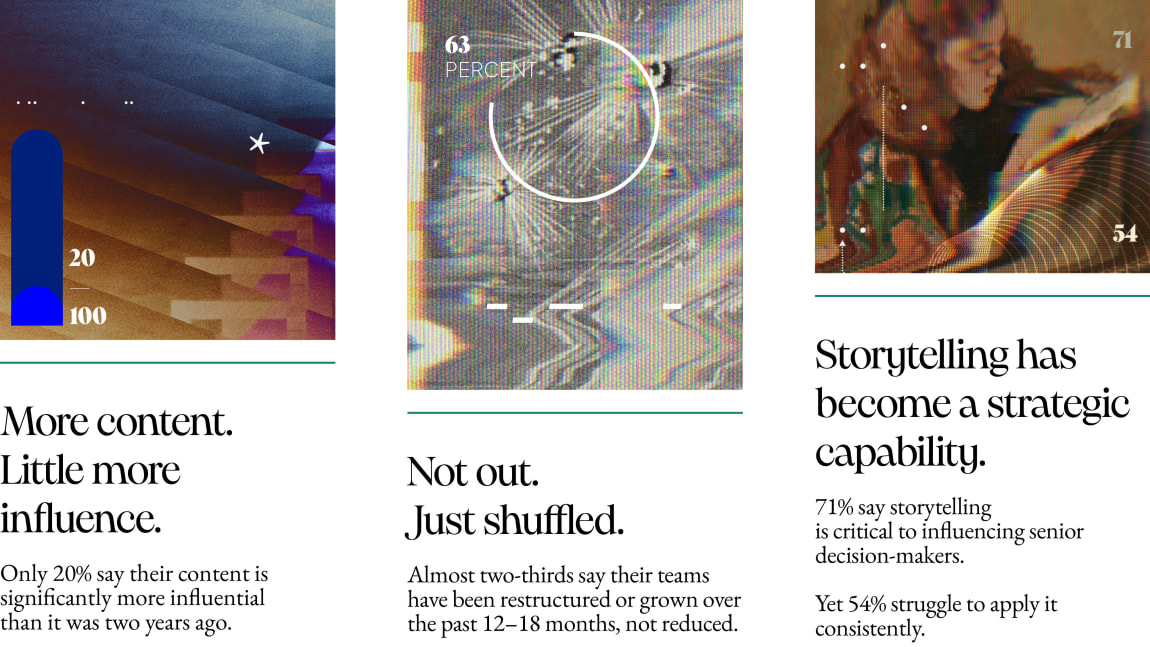
One finding in this year’s Global Marketing Leaders Content Study captures that tension perfectly. Only 20% of marketing leaders say their content is delivering significantly greater influence than it did two years ago.
Of course, we wanted to know why.
AI has accelerated content creation dramatically. But in doing so, as our study reveals, it has made cutting through the defining challenge for marketing leaders today.
How do you keep your ideas fresh when it feels like everything has already been said? How do you develop a point of view that genuinely stands out? How do you turn expertise into content that people actually remember?
These are the questions at the heart of this year’s study. And the findings point clearly to where the answers lie.
The first is people, and the skills becoming most valuable in an AI-enabled world. The second is expertise, and how organisations unlock the knowledge already inside their business and turn it into a sustained source of authority. The third is investment, and where the leaders pulling ahead are choosing to put their resources.
1 — People
2 — Expertise
3 — Investment
The influence gap
Satwant Wishart and Gareth Lofthouse discuss why AI is making content faster and cheaper without necessarily making it more influential, and why originality and differentiation remain such a challenge.
Speakers: Satwant Wishart, Founder & CEO, Pandher Wishart Studios and Gareth Lofthouse, Founder & MD, Resonant
Satwant Wishart
So AI is certainly making us faster, it's making us more efficient. It's certainly making content making cheaper. But that's not necessarily equaling more influence, is it?
Gareth Lofthouse
No. And this gets us to the crux of well, a tension, if you like, in the research. When we asked respondents, are you getting more impact now versus 18 months ago? Only 20% say yes. But that's pretty disappointing given the efforts being thrown into this technology.
Satwant Wishart
And that is a real shame because we know that content should influence, it should engage, and ultimately, it should drive business growth.
And what's going wrong? The first challenge when it comes to using AI in content making comes down to differentiation. How do we say something and look different to our competitors when often we're talking about the same things and now we're using the same tools.
Next, when we're using AI, ensuring that it's factual and accurate. The faster we need to move, that's when it becomes even more essential to be fact-checking and ensuring that the quality of work doesn't drop.
Gareth Lofthouse
Companies are rushing to adopt, and maybe they're running before they can walk. Only 20% said they had this governance in place. That's a bit of a risk factor in. And maybe there could be a factual slip up. We've seen some pretty well-publicised stories where some major brands have got their fingers burnt on this.
For those I think companies will put their house in order on that.
What they're going to struggle with more is that point about an original insight, an original point of view.
There's a danger that we just use AI to pump up the volume and sort of spread the airwaves, if you like, with more mediocrity. Well, that's not actually going to do anything for anyone.
I’ve always believed the future B2B marketing team looks like what I call a corporate newsroom. It’s always-on, delivering a consistent drumbeat of content with the ability to deliver stories that audiences trust and remember.
With AI in the mix, technology accelerates production. But human expertise, editorial judgement and storytelling still determine influence.
This report explores what that future looks like.
A profession in transition
162 senior B2B marketing leaders across complex industries share what is working, what is not, and where content is heading next.
Read next:
Chapter 1: People - Marketing’s new capability mix
Chapter 2: Turning expertise into influence